Peace Sign Applique
A Designer’s First Look: Calm, Clear, and Craft-Ready
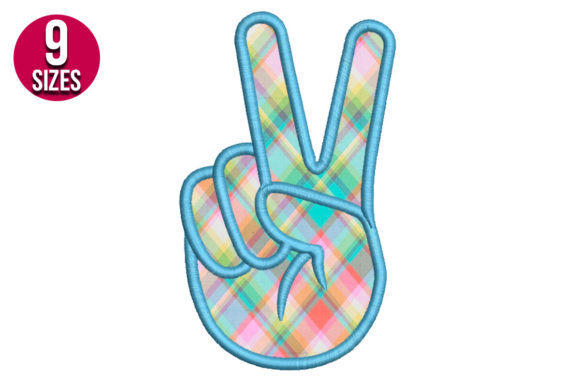
When I opened Peace Sign Applique, my first thought wasn’t “cute” or “trendy”—it was “this feels intentional.” The shape is clean but not sterile: the peace symbol’s circle-and-three-lines motif flows with gentle curves, no sharp corners to snag thread or frustrate hooping. It’s sized just right—not so small it disappears on a tote bag, not so large it overwhelms a baby onesie. As an Inspirational embroidery design, it avoids cliché. There’s no dove, no rainbow, no overwrought script—just quiet confidence in its form. That makes it unusually versatile for real-world use.
Real Project Test: A Linen Tote Bag for a Local Bookstore Pop-Up
Last week, I used Peace Sign Applique on a natural linen tote for a neighborhood bookstore’s summer launch. Why this design? Because their brand voice leans thoughtful, unhurried, and grounded—not flashy. The applique stitched cleanly on medium-weight linen with tear-away + light cut-away stabilizer. The satin stitch outline held crisp definition, while the fill stitch inside the circle stayed smooth, not puffy. Customers paused mid-aisle to touch it—not because it glittered, but because it felt *deliberate*. That’s the difference between decoration and design.
Where It Shines (and Where to Pause)
Peace Sign Applique works beautifully across several common embroidery project categories—but context matters:
- Custom apparel: Looks especially strong on relaxed-fit sweatshirts and organic cotton tees. The open negative space in the symbol breathes well on knit fabrics without pulling.
- Tote bag design & home decor: Holds up at 4–5 inches wide. On canvas or denim, it reads clearly from across a craft fair booth.
- Baby embroidery & nursery decor: Gentle enough for onesies or muslin pillow covers—but avoid dense fill stitch areas near seams where stitching could stiffen delicate fabric.
- Embroidered patch: Works as a standalone iron-on if digitized with proper underlay and tack-down stitches (verify your file includes those).
Proceed with care on:
- Curved surfaces like caps: The symmetrical layout helps, but test hoop placement first—the circle can distort if hooped off-center.
- Thin or stretchy fabric: Use cut-away stabilizer and baste before embroidering. The design’s balance depends on stable fabric tension.
- Dark fabric: Opt for high-contrast thread colors (e.g., ecru on navy, charcoal on cream). Avoid matching thread—it fades into background noise.
- Frequent-wash items (kitchen towels, kids’ clothes): Check stitch density—overly dense fills may harden after repeated laundering.
What It Adds to Your Finished Product—Beyond Aesthetics
This isn’t just another machine embroidery design. It quietly elevates perception of your handmade product:
- Visual appeal: Its symmetry and rhythm create instant visual rest—valuable in a crowded Etsy listing or boutique shelf.
- Customer trust: Clean execution signals professionalism. Buyers assume better materials, better construction, and attention to detail—even before they hold the item.
- Giftability: Paired with neutral packaging, Peace Sign Applique reads as meaningful but never prescriptive—ideal for birthday gifts, teacher appreciation, or wellness-themed merchandise.
- Brand consistency: For small shop owners building a cohesive line, it slots neatly beside botanical motifs or minimalist typography—no jarring tonal shift.
Practical Notes Every Embroidery Designer Should Check
Before cutting fabric or uploading to your machine:
- Test on scrap first. Linen, cotton poplin, and fleece behave differently—even with the same stabilizer.
- Review thread colors. Try it in monochrome mockups: does the shape read clearly in black-and-white? If not, adjust contrast or simplify fill areas.
- Confirm hoop size compatibility. Does your version fit comfortably in a 4x4 or require 5x7? Don’t assume—measure the design bounding box.
- Inspect small details. Zoom in on the junctions where lines meet the circle. Are stitches overlapping cleanly? Or do you see gaps that’ll need manual touch-ups?
- Compare light/dark backgrounds. Stitch it on both white and charcoal fabric scraps. Does the same thread palette work both ways—or do you need two versions?
- Use proper stabilizer. Lighter weight = more drape; heavier = more structure. Match it to your end use (e.g., cut-away for baby items, tear-away for tea towels).
- Verify licensing. If you’re an Etsy seller or craft business owner, confirm whether the digital embroidery file permits commercial use of finished items—and whether resale of the file itself is prohibited.
Final Thought: Design With Purpose, Not Just Pattern
Peace Sign Applique doesn’t shout. It settles. That’s rare in today’s flood of fast, formulaic embroidery file collections. As a designer who ships custom orders weekly, I value pieces that let the maker’s intention shine through—not drown in embellishment. Whether you’re stitching a single personalized gift or producing a batch of boutique merchandise, this design gives you room to breathe, to choose wisely, and to make something that feels quietly significant. It’s not just a symbol. It’s a reminder: good design serves the hand that makes it—and the hands that hold it.